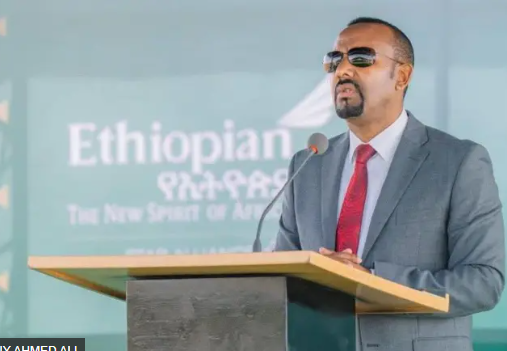
In a rare and striking admission that critics are framing as a clear acknowledgment of his administration’s inability to maintain basic public safety, Ethiopian Prime Minister Abiy Ahmed has openly lamented the severe security breakdown that has left citizens unable to move freely across parts of the Amhara and Oromia regions. Speaking at the official inauguration ceremony of the newly opened King Teklehaimanot Airport in Debre Markos, the capital of the East Gojjam Zone, the Prime Minister addressed the stark and perilous realities facing ordinary travelers. While the event was intended to celebrate Ethiopian Airlines’ expansion into its 25th domestic destination, the backdrop of the ceremony was heavily overshadowed by a three-year-old regional conflict and a collapsing road transport security network.
For years, regional transport to cities like Debre Markos relied on affordable cross-country road networks, but Abiy admitted that ground travel has become profoundly compromised. In an unusual rhetorical turn, he noted that while residents historically had options, both plane and car travel have faced immense problems in recent years, leaving local populations effectively trapped. Opposition figures argue that the inauguration of the airport highlights a deeper systemic failure of governance, suggesting that rather than securing critical ground infrastructure for working-class citizens, the state is offering commercial air travel as a forced alternative. Abiy himself explicitly acknowledged this financial disparity, noting that those who cannot afford a plane ticket face immense hardship when trying to travel to the capital or elsewhere, underscoring that economic reality has left poorer citizens entirely exposed to the security vacuum on the highways.
The most pointed segment of the Prime Minister’s speech centered on the notorious Ali Doro corridor in the North Shoa Zone of the Oromia region, a vital artery connecting Addis Ababa to the Amhara region that has instead become a site of terror. Passengers traveling through this area have frequently been subjected to mass blockades, targeted kidnappings, and extrajudicial killings. While the federal government has repeatedly laid blame on the Oromo Liberation Army militant group, the insurgents have countered by accusing government-organized elements of orchestrating the violence themselves. Rather than outlining a definitive state-led security breakthrough to protect these citizens, Abiy used his speech to call for collective local action against the insurgencies, urging the public to fight together to rid the Nile Valley and Ali Doro areas of bandits. For political observers, this pivot is seen as an attempt to shift the burden of security onto a fatigued population, highlighting the administration’s limitations in resolving a conflict that has paralyzed regional economies and fractured national stability since it erupted nearly three years ago.