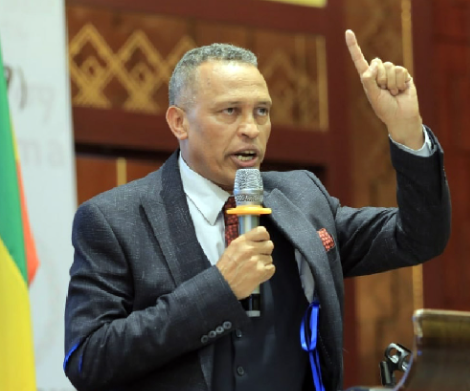
The federal government’s push to secure a new political mandate through the upcoming seventh general election faces severe questions of legitimacy following the National Electoral Board of Ethiopia’s (NEBE) admission that voting cannot take place in key conflict-torn areas, including eight critical constituencies in the Amhara region. By proceeding with a national ballot while active warfare effectively disenfranchises massive segments of the population, authorities are drawing intense criticism from analysts and opposition groups who argue that any resulting victory will lack genuine democratic authority.
NEBE Chairperson Melat Gold confirmed that a total of 46 constituencies across the country will be entirely excluded from the May 24 poll. Alongside a blanket postponement in the Tigray region affecting 38 constituencies, the board revealed that eight out of 138 constituencies in Amhara—specifically across South Gondar, West Gondar, Ambassel, and Dega Damot—will see no voting activity. With no timeline established for when, or if, these citizens will ever cast their ballots, critics contend that holding an election under the shadow of military operations and active clashes with Fano militias turns the democratic process into a selective exercise designed to entrench the current administration rather than reflect the will of the people.
The erosion of the election’s credibility is further compounded by severe institutional disruptions and the mass exclusion of candidates. While 42 parties remain in the race, six have been forced out, including a court-mandated withdrawal that stripped 309 candidates from the Social Democratic Party of Ethiopia (ESDP) of their ability to compete, alongside 80 other candidates rejected by the board for missed deadlines. Furthermore, NEBE was forced to cancel voter registration entirely at several polling stations across the Amhara Regional Treasury, Oromia, Benishangul-Gumuz, and the Somali region after video and documentary evidence exposed severe registration irregularities. Despite these clear signs of a compromised electoral landscape and deep regional alienation, the federal government’s insistence on finalizing the vote for the House of Peoples’ Representatives threatens to deepen, rather than resolve, the nation’s political fractures.